Table of Contents
As of January 25, 2026, the gears of the Indian bureaucracy are finally turning for over 1.1 crore central government employees and pensioners. While the 7th Pay Commission’s tenure officially ended on December 31, 2025, the government has already notified the Terms of Reference (ToR) for the 8th Central Pay Commission as of November 3, 2025. This isn’t just about a “raise”; it’s a massive recalibration of the Indian middle-class economy, affecting everything from basic pay to retirement security.
Key Takeaways TL;DR
- Formal Start: The 8th Pay Commission is officially constituted, with office space recently allotted in Chandralok Building, Janpath, New Delhi.
- Crucial Date: A major meeting of the National Council (Staff Side) JCM is scheduled for February 25, 2026, to finalize employee demands.
- Effective Timeline: The new pay structure is expected to be effective from January 1, 2026, meaning even if the final notification is delayed, employees will likely receive arrears backdated to this month.
8th Pay Commission DA Calculator
Calculate your Dearness Allowance under 8th Pay Commission. Find current DA percentage, understand DA merger impact, and plan your finances accordingly.
✓ Based on AICPI-IW data (November 2025) | Last Updated: January 21, 2026
Calculate Your DA
Compare DA Impact
Your DA Calculation Results
Frequently Asked Questions About DA
Dearness Allowance (DA) is a cost-of-living adjustment provided by the Government of India to central government employees and pensioners. It’s designed to protect employees from the erosive effects of inflation on their salary.
Key Facts:
- DA is calculated as a percentage of basic pay
- It’s revised twice a year (January and July)
- Current DA (Jan 2026): 60% of basic pay
- DA is fully taxable income
DA is calculated using a formula based on the All-India Consumer Price Index for Industrial Workers (AICPI-IW):
Where 306.33 is the base index for the 7th Pay Commission.
Example: If your basic pay is ₹50,000 and DA is 60%, your monthly DA is ₹30,000.
When the 8th Pay Commission is implemented (expected late 2026 or early 2027):
- DA Merger: Your accumulated DA (currently ~60%) will be merged into your basic pay permanently
- DA Reset: DA resets to 0% and starts growing again from new inflation adjustments
- Higher Base: Your new basic pay will be significantly higher
- Better Growth: Future DA increases will be calculated on the higher base
Example: If basic pay is ₹50,000 + DA ₹30,000, new basic becomes ~₹80,000 and DA starts at 0%.
DA increases are determined by changes in the AICPI-IW index. The government typically announces DA hikes in full percentage points (1%, 2%, 3%, etc.) rather than fractions.
Recent DA Changes:
| Period | DA % | Increase |
| January 2025 | 55% | +2% |
| July 2025 | 58% | +3% |
| January 2026 | 60% | +2% |
Yes, DA is fully taxable. Dearness Allowance is treated as part of your salary and is subject to income tax deductions.
Tax Implications:
- DA is added to your gross salary for tax calculation
- It counts toward your taxable income slab
- You can claim standard deduction on total salary including DA
- DA received as arrears may push you into a higher tax bracket
DA is specifically designed to match inflation measured by the AICPI-IW (All-India Consumer Price Index for Industrial Workers). However, there are important nuances:
Key Points:
- AICPI measures inflation for industrial workers (base year 2016 = 100)
- DA revisions are based on 12-month rolling average
- DA provides 100% inflation neutralization at all pay levels
- Real inflation (CPI) and AICPI-IW may differ slightly
Eligible:
- Central government employees (Groups A, B, C, D)
- Defence forces personnel
- Central government pensioners
- Dearness Relief (DR) for pensioners—same as DA for employees
- All India Services (IAS, IFS, IPS)
Not Eligible:
- Private sector employees
- Contract/temporary workers
- State government employees (unless state adopts)
DA (Dearness Allowance): For employees, calculated as percentage of basic pay
DR (Dearness Relief): For pensioners, calculated as percentage of basic pension
Both are revised simultaneously at the same rates. The only difference is the base (basic pay vs. basic pension). For example, if DA is 60%, then DR is also 60% for pensioners.
The fitment factor is a multiplier applied to your basic pay when a new Pay Commission is implemented. It affects DA in the following way:
Current Situation (7th CPC):
- Basic Pay: ₹50,000
- DA (60%): ₹30,000
- Total: ₹80,000
After 8th CPC (with fitment factor 2.57):
- New Basic Pay: ₹1,28,500 (₹50,000 × 2.57)
- DA (Reset to 0%): ₹0 (starts growing again)
- Total initially: ₹1,28,500
- As DA grows to 2% → 3%, it will be added to this higher base
What Has Been Announced (Confirmed vs Pending)
Navigating government notifications can feel like reading a riddle. Here is the breakdown of what is written in stone and what is still under deliberation.
The Confirmed:
The Ministry of Finance, via its Resolution dated November 3, 2025, has officially approved the Terms of Reference for the 8th CPC. The commission has been given a mandate of 18 months to submit its final report. Furthermore, on January 20, 2026, office accommodation was formally allotted to the Commission staff, signaling that data collection from various ministries is beginning.
The Pending:
While the fitment factor is the most discussed topic in office canteens, it remains pending. The government has not yet finalized whether the multiplier will be 2.57 (as in the 7th CPC) or the 3.25 demanded by employee federations. Additionally, the exact date when the first “revised” paycheck will hit bank accounts is unknown, though historical trends suggest a mid-2027 rollout with retrospective effect.
Who Is Eligible — and Who Is Not
The 8th Pay Commission’s reach is vast, but it does not cover everyone working in a government building.
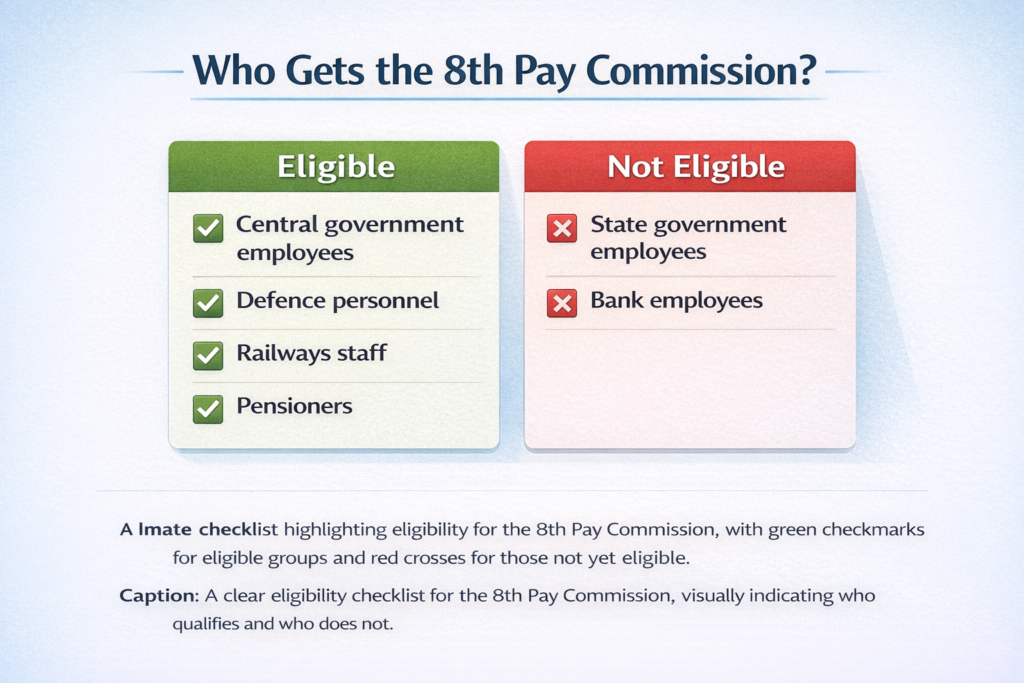
- Eligible:
- 50.14 lakh Central Government Employees (Railways, Posts, Defence, Income Tax, etc.).
- 69 lakh Pensioners who retired from central services.
- State Government Employees (typically, states adopt central recommendations within 6–12 months of the Centre’s notification).
- Not Eligible:
- Contractual workers and daily-wage earners.
- PSU Employees (they follow separate Wage Revision agreements, though the 8th CPC report often acts as a benchmark).
- Private sector employees, except those in sectors where salaries are legally tied to government pay scales (rare).
Benefits Explained Simply
The primary goal of the 8th Pay Commission is to offset the cost of living increases seen over the last decade.
A. The Fitment Factor (The Multiplier)
The fitment factor is the magic number used to arrive at your new basic pay. If your current basic is X and the fitment factor is 2.86, your new basic becomes X times 2.86. This “fitment” essentially merges the existing Dearness Allowance (DA) into the basic pay and adds a “real hike” on top.
B. DA Merger and Reset
Currently, DA has reached or crossed the 50-70% mark (projected). Under the new commission, this DA is typically reset to 0% because it has been integrated into the new, higher basic pay. This simplifies the pay structure and increases the base for future HRA and TA calculations.
C. Pension Revision
For retirees, the 8th CPC is expected to provide a 20-30% hike in pensions. This is crucial for senior citizens facing medical inflation, which often outpaces the standard Consumer Price Index.
Comparison Table: 7th CPC vs. 8th CPC (Projected)
| Feature | 7th Pay Commission (Current) | 8th Pay Commission (Projected) |
| Minimum Basic Pay | ₹18,000 | ₹21,600 – ₹41,000 (Varies by demand) |
| Fitment Factor | 2.57 | 2.86 – 3.25 (Expected) |
| Minimum Pension | ₹9,000 | ₹20,500 – ₹25,740 |
| Status | Implemented (2016) | Under Review (2026) |
| Implementation Delay | ~2.5 Years | ~18-24 Months (Estimated) |
The Skeptic’s View
Most people think that a “new pay commission” means an immediate, massive windfall in February 2026. However, the Finance Ministry’s notification clearly states the commission has 18 months to submit its report.
As a skeptic, I must point out that while the effective date is January 1, 2026, the payment date will likely be in 2027. This means you will see a massive “Arrears” payout, but your monthly take-home won’t change tomorrow. Don’t go booking that expensive vacation on credit just yet.
My Take
In my two decades of tracking government policy, I’ve noticed a pattern: the government uses these 18-month “study periods” to manage its fiscal deficit. By the time the 8th CPC is actually implemented in 2027, the real value of the hike might already be partially eroded by inflation.
I believe the upcoming February 25, 2026 meeting of the NC-JCM is the most important event to watch. This is where the unions will decide if they want to push for a “Graded Fitment Factor” (higher hikes for lower-level employees) or a flat multiplier. If you are a Level 1 to Level 5 employee, this meeting determines your financial future for the next ten years.
What Should You Do Now?
- Check Your Pay Level: Ensure your service records are updated. Your 8th CPC fixation will depend entirely on your current Pay Matrix Level (Level 1 to 18).
- Plan for Arrears: Treat the upcoming hike as a “forced saving.” Since the hike is retrospective, start planning how to invest the lump-sum arrears you will receive in 2027.
- Monitor Feb 25 Updates: Follow official channels (PIB or JCM circulars) on February 25, 2026. The demands finalized there will be the “maximum possible” outcome you can expect.
Sources & References
- Press Information Bureau (PIB) – Terms of Reference Approval
- Department of Expenditure, Ministry of Finance – Circulars
- NC-JCM Staff Side – Meeting Notice Feb 2026
- The Sunday Guardian – 8th CPC Office Status Update
Disclaimer
This article is for informational purposes only. While based on official government resolutions and credible reports as of January 2026, the final recommendations of the 8th Pay Commission are subject to Union Cabinet approval and may differ from current projections.